

The temperature of the outer shell of industrial kilns varies, and the higher the operating temperature, the higher the temperature of the kiln outer skin. To reduce the temperature of the kiln outer skin, it is necessary to improve the use of insulation materials or thicken the insulation layer.
In general, lightweight clay bricks, lightweight fiberboard, cotton, and blankets are commonly used for insulation. But if fiber insulation materials are used, lightweight clay bricks are not needed, and if lightweight clay bricks are used, fiber insulation materials cannot be used.
However, if the temperature of the kiln skin is required to be low, multi-layer insulation should be applied to reduce the diffusion of heat and lower the temperature of the kiln skin.
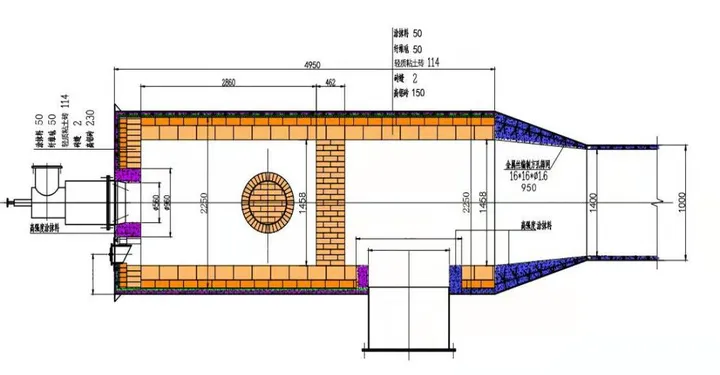
Multi layer insulation requires three layers. The first layer is lined with 50mm thick lightweight coating material, the second layer is insulated with 50mm thick high-purity fiberboard, and the third layer is lined with 0.6 density lightweight clay bricks for insulation. This multi-layer insulation will significantly reduce the temperature of the kiln outer skin. Generally, when used at a temperature of 1000 ℃, the temperature of the kiln outer skin will decrease by about 100 ℃ when using three layers of insulation.
After applying the lining, the airtightness of the entire furnace lining becomes stronger, and the heat dissipation speed slows down; The high-purity fiberboard on every second layer has a better heat reduction effect. Every three layers, lightweight clay bricks with a density of 0.6 are used, with a brick thickness of 114mm. This results in a thickness of 224mm for the entire insulation layer. The thickening of the insulation layer slows down the heat rate and prevents it from directly dissipating through the kiln to the kiln skin.
The temperature of the kiln outer skin is significantly reduced, and at the same time, it has strong airtightness and slow heat dissipation speed, which can ensure the internal use temperature of the kiln lining. The internal temperature of the kiln lining lasts for a long time, and it can also reduce the fuel problem used for heating the kiln body. Reducing fuel reduces production and usage costs.
That is to say, using three-layer insulation materials such as coating, fiberboard, and lightweight clay bricks as insulation layers can lower the temperature of the kiln outer skin and save fuel, making it a win-win solution for insulation.